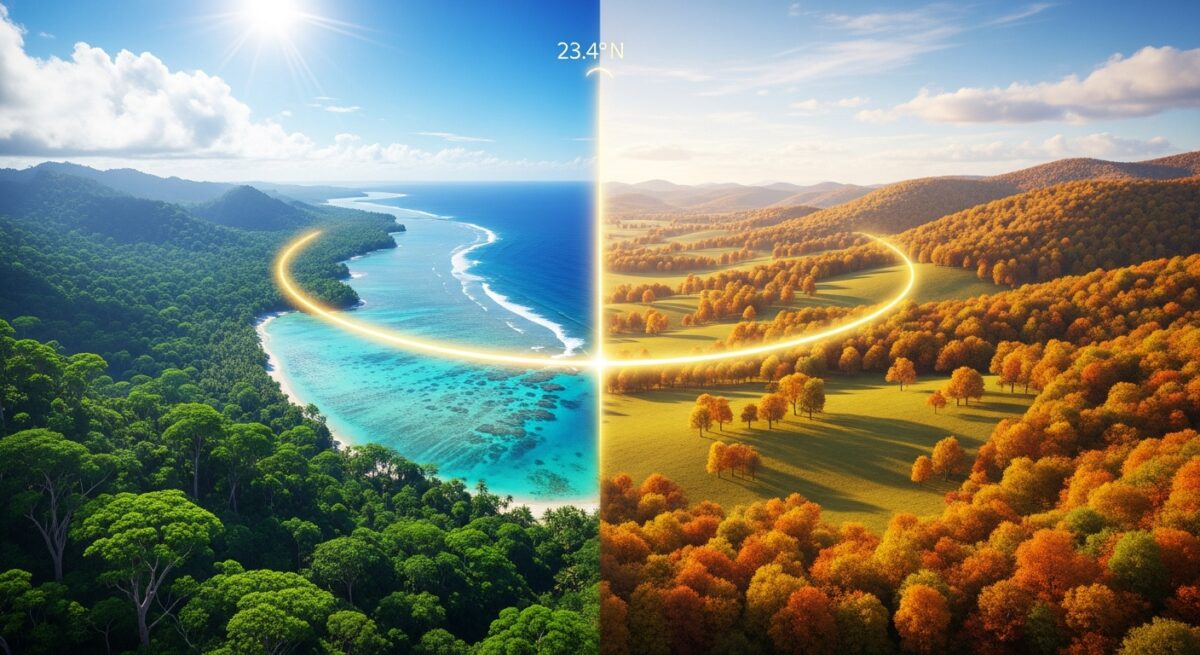
Understanding the Tropic of Cancer and Earth’s Climate Zones
Imagine a line circling the globe, an invisible boundary where the sun can be directly overhead at its highest point. This is the Tropic of Cancer, one of the most significant geographical markers on our planet. It is more than just a line on a map, it is a fundamental component of Earth’s climatic architecture, influencing weather patterns, ecosystems, and human civilizations for millennia. Its position defines the northern limit of the tropics, creating a belt of generally warm, stable climates that starkly contrast with the temperate and polar zones. Understanding this celestial line unlocks a deeper comprehension of seasonal change, solar energy distribution, and the diverse environmental regions that shape life on Earth.
The Geographic and Astronomical Definition
The Tropic of Cancer is a circle of latitude currently located at approximately 23.4 degrees north of the Equator. Its precise position is not fixed, it fluctuates very slowly over a cycle of about 41,000 years due to a slight wobble in Earth’s axial tilt, known as axial precession. This line is one of the five major circles of latitude marked on maps, alongside the Equator, the Tropic of Capricorn, the Arctic Circle, and the Antarctic Circle. Astronomically, it holds a special significance. It marks the northernmost latitude where the sun appears directly overhead at solar noon. This event, known as the June solstice or summer solstice in the Northern Hemisphere, occurs around June 21 each year. On this day, the sun’s rays strike the Tropic of Cancer at a 90-degree angle, resulting in the longest day of the year for locations north of the Equator.
The naming of this line has ancient roots, dating back over two millennia. The term “Cancer” is derived from the Latin word for crab, referencing the constellation Cancer that the sun appeared to be in during the June solstice at the time of its naming by ancient astronomers. While the sun’s apparent position has shifted into the neighboring constellation Gemini due to precession, the historical name remains. This celestial connection highlights how human observation of the stars and sun was intrinsically linked to understanding our place on Earth. The counterpart to this line in the Southern Hemisphere is the Tropic of Capricorn, situated at approximately 23.4 degrees south latitude, where the sun is directly overhead during the December solstice.
Climate and Environmental Impact
The position of the Tropic of Cancer is a primary driver of global climate zones. The region between the Tropic of Cancer and the Tropic of Capricorn is known as the tropics, or the torrid zone. This area receives the most direct and consistent solar radiation year-round, leading to generally warm temperatures with minimal seasonal variation in terms of heat. However, this does not mean the climate is uniform. The interplay between the consistent heat and atmospheric circulation patterns creates distinct environmental regimes. The most notable climatic feature associated with the tropics is the presence of the Intertropical Convergence Zone (ITCZ), a belt of low pressure where trade winds from the Northern and Southern Hemispheres converge. This convergence forces air upward, leading to prolific cloud formation and heavy rainfall.
As the ITCZ migrates north and south throughout the year, following the sun’s most direct rays, it creates pronounced wet and dry seasons for many regions near the Tropic of Cancer. Locations directly on the tropic often experience a climate that can be arid or semi-arid. This is because they lie on the fringe of the tropical rain belt, experiencing the ITCZ’s influence only during part of the year. For much of the year, these areas are under the influence of subtropical high-pressure systems, which promote dry, stable conditions. This explains why some of the world’s major deserts, such as the Sahara in Africa, the Arabian Desert in the Middle East, and the Sonoran Desert in North America, are found in the vicinities of the Tropic of Cancer. The specific climate at any point along the line is further modified by local factors like ocean currents, altitude, and proximity to large water bodies.
The key environmental and climatic characteristics of regions influenced by the Tropic of Cancer include:
- High Solar Insolation: Consistently high angles of incoming solar radiation result in significant warmth.
- Seasonal Rainfall Patterns: Distinct wet seasons often linked to the migration of the ITCZ, and long dry seasons dominated by high pressure.
- Diverse Biomes: Ranges from lush tropical forests where moisture is abundant to expansive deserts where arid conditions prevail.
- Hurricane Formation: The warm ocean waters near the tropics provide the energy for tropical cyclones (hurricanes/typhoons) to form and intensify.
Countries and Landmarks Along the Line
The Tropic of Cancer passes through 16 countries, three continents, and six bodies of water, making it a truly global feature. Its path takes it through some of the world’s most diverse landscapes and cultures. Starting in the Atlantic Ocean, the line crosses North Africa, cutting through the Western Sahara, Mauritania, Mali, Algeria, Niger, Libya, and Egypt. In Egypt, it famously passes near the iconic Great Sphinx and the Pyramids of Giza, a testament to ancient civilizations that meticulously observed the sun’s path. From Africa, the tropic moves into Asia, traversing the Red Sea before crossing Saudi Arabia, the United Arab Emirates, Oman, India, Bangladesh, Myanmar, and China. In India, the tropic is marked prominently in the city of Bhopal, and it passes through the heart of the country, influencing its classic monsoon climate.
Finally, the line crosses the continent of Asia and enters the Pacific Ocean, only to make its last landfall across North America. It slices through Mexico and the Bahamas. In Mexico, it passes through the states of Baja California Sur, Sinaloa, Durango, Zacatecas, San Luis Potosi, Nuevo Leon, and Tamaulipas. The Hawaiian Islands, though often associated with the tropics, lie just south of the Tropic of Cancer. The landmarks along this latitude are not just geographical, they are cultural and historical. From the ancient pyramids aligned with celestial events to modern monuments marking the line’s passage, humans have long recognized the significance of this astronomical boundary. For a deeper exploration of how environmental factors influence health and wellness planning in different regions, Read full article for resources that consider geographic and climatic variables.
Cultural and Historical Significance
The Tropic of Cancer has held profound meaning for human societies throughout history. Ancient cultures without modern instruments were keenly aware of the sun’s changing path. The solstice events, which define the tropics, were often marked with monuments, rituals, and calendars. Structures like Stonehenge in England (though far north of the tropic) and the Pyramid of the Sun at Teotihuacan in Mexico demonstrate the importance of tracking the sun’s extreme positions. For agricultural societies, predicting the solstices and the accompanying seasonal shifts in rainfall and temperature was a matter of survival. It dictated planting and harvesting times, water management, and community planning.
In literature and popular culture, the Tropic of Cancer often symbolizes a boundary, a limit, or a place of extreme climate. Henry Miller’s controversial 1934 novel titled “Tropic of Cancer” used the geographic concept as a metaphor for a personal and societal low point. More broadly, the phrase evokes images of relentless heat, exotic locales, and the edge of the known world. In modern times, the line is a key concept in geography education, helping students visualize and understand the reasons behind Earth’s climate diversity, seasonality, and the unequal distribution of solar energy. It remains a fundamental reference point for navigators, climatologists, and anyone seeking to understand the physical drivers of our planet’s weather and climate systems.
Frequently Asked Questions
Does the Tropic of Cancer move?
Yes, the Tropic of Cancer is not fixed. Its latitude oscillates very slowly between approximately 22.1 and 24.5 degrees north over a 41,000-year cycle due to changes in Earth’s axial tilt. Its current latitude is about 23.4 degrees north.
What is the difference between the Tropic of Cancer and the Equator?
The Equator (0 degrees latitude) is the midline of Earth, dividing the Northern and Southern Hemispheres. The sun is directly overhead at the Equator during the two equinoxes. The Tropic of Cancer (23.4 degrees N) is the northernmost line where the sun can be directly overhead, which happens only once a year at the June solstice.
What kind of climate is found at the Tropic of Cancer?
There is no single climate. Due to global wind patterns and geography, climates can range from hyper-arid desert (e.g., Sahara) to tropical monsoon (e.g., parts of India). A common feature is high temperatures with a pronounced seasonal shift between wet and dry periods in many locations.
Why is it called the Tropic of Cancer?
It was named over 2,000 years ago when the sun, during the June solstice, appeared in the constellation Cancer. Due to the precession of the equinoxes, the sun now appears in the constellation Gemini during the solstice, but the traditional name persists.
What is the opposite of the Tropic of Cancer?
Its direct counterpart is the Tropic of Capricorn, located at approximately 23.4 degrees south latitude. It marks the southernmost point where the sun can be directly overhead, during the December solstice.
The Tropic of Cancer is far more than a cartographic convention. It is a dynamic line, a product of celestial mechanics that in turn dictates terrestrial reality. It shapes deserts and monsoons, influences where hurricanes brew, and has guided human civilization for centuries. From the pyramids of Giza to the monsoon plains of India, its invisible presence is felt in the climate, ecology, and culture of the regions it touches. Understanding this key geographic concept provides a foundational lens through which to view the interconnected systems of our planet, reminding us that the rhythms of the sun and Earth are the ultimate architects of our global home.



