
Understanding Eye Cancer: Symptoms, Types, and Treatment Options
This guide details the symptoms, types, and modern treatments for eye cancer, emphasizing the critical role of early detection in preserving vision and improving outcomes.

By Edward Langley
Compare health plans
Finding plans in your area…
While the thought of cancer developing in the eye can be unsettling, knowledge is a powerful tool for early detection and effective management. Eye cancer, though rare, encompasses a group of diseases where malignant cells form in the tissues of the eye. Understanding the signs, knowing the risk factors, and being aware of the diagnostic and treatment pathways can significantly impact outcomes. This guide provides a comprehensive look at ocular oncology, from the subtle early warnings to the latest therapeutic advances, empowering you with essential information about this serious condition.
What Is Eye Cancer?
Eye cancer is a broad term for any cancer that starts in the eye. It is also known as ocular cancer. The disease originates when healthy cells in or around the eye change and grow uncontrollably, forming a mass called a tumor. Tumors can be benign (non-cancerous) or malignant (cancerous). Malignant tumors can invade and destroy nearby healthy tissue and may spread (metastasize) to other parts of the body. Primary eye cancer starts within the eye itself, while secondary eye cancer, which is more common, spreads to the eye from another part of the body, such as the breast or lung. Understanding the origin is crucial for determining the correct treatment approach, similar to how specialists approach the diagnosis and treatment of metastatic cancer from other sites.
Primary Types of Eye Cancer
Several distinct types of cancer can affect the eye, each with unique characteristics, typical locations, and behaviors. The most common primary intraocular cancers in adults are melanoma and lymphoma. In children, retinoblastoma is the most significant type.
Intraocular Melanoma
Intraocular melanoma is the most common primary eye cancer in adults. It develops from melanocytes, the cells that produce pigment. While it can occur in any part of the uvea (the eye’s middle layer), it most frequently arises in the choroid, a layer of blood vessels that nourishes the retina. Uveal melanoma is a serious diagnosis because it has the potential to metastasize, often to the liver. Early detection is critical, as smaller tumors are associated with a much better prognosis and more vision-preserving treatment options.
Intraocular Lymphoma
Intraocular lymphoma is a type of non-Hodgkin lymphoma that primarily affects the eye. It often involves the vitreous (the gel-like fluid inside the eye), the retina, or the optic nerve. This cancer is frequently associated with primary central nervous system lymphoma (PCNSL), meaning it can also affect the brain and spinal cord. Diagnosis can be challenging, as its symptoms often mimic those of uveitis (eye inflammation).
Retinoblastoma
Retinoblastoma is a rare eye cancer that almost exclusively affects young children, typically under the age of five. It develops in the retina, the light-sensitive lining at the back of the eye. This cancer is often caused by a genetic mutation. A classic early sign is leukocoria, where the pupil appears white or pink in photographs instead of red (the “red-eye” effect). Other signs include a crossed eye (strabismus) or poor vision. Advances in treatment have made retinoblastoma one of the most curable childhood cancers, especially when caught early.
Recognizing the Symptoms and Signs
Symptoms of eye cancer can be subtle or absent in the early stages, which is why regular comprehensive eye exams are vital. When symptoms do occur, they may not be exclusive to cancer and could indicate other, less serious conditions. However, any persistent change in vision or eye appearance warrants a prompt evaluation by an ophthalmologist. Common signs and symptoms include:
- Blurred vision or sudden vision loss: A gradual or sudden decrease in clarity.
- Floaters or flashes of light: The sudden appearance of many floaters or persistent flashes.
- A growing dark spot on the iris: The colored part of the eye.
- Change in the size or shape of the pupil: The black circle in the center of the iris.
- A visible lump on the eyelid or eyeball: Any growth that increases in size.
- Bulging of the eye (proptosis): The eye appears to be pushed forward.
- Change in eye movement or position: The eyes may not align properly.
- Pain in or around the eye: Though many eye cancers are painless, pain can occur.
It is important to note that many symptoms, like flashes and floaters, are common and usually benign. However, a sudden increase or change in their pattern should never be ignored. Just as with other cancers, being vigilant about bodily changes is key. For instance, understanding subtle bodily signals is also discussed in resources about the potential connection between excessive burping and cancer in different contexts.
Diagnosis and Staging of Ocular Tumors
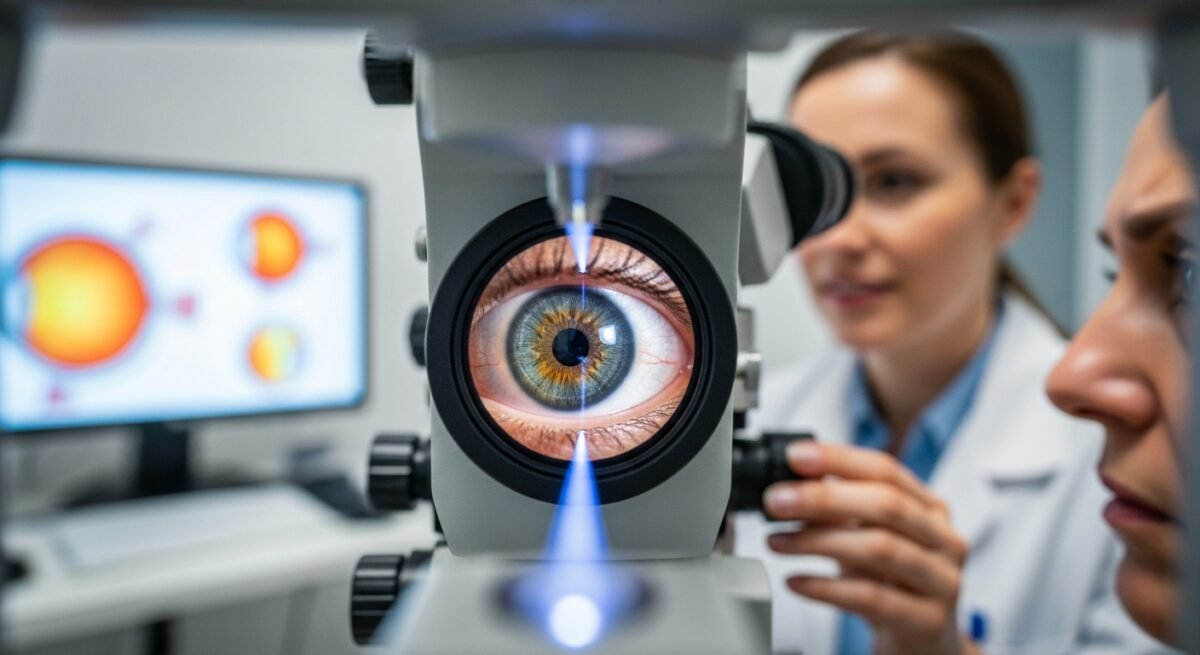
Diagnosing eye cancer involves a series of specialized tests performed by an ophthalmologist, often one who specializes in ocular oncology. The process begins with a detailed medical history and a comprehensive eye exam. The doctor will dilate the pupils to get a clear view of the retina and internal structures. Several imaging technologies are then employed to visualize the tumor in detail and aid in diagnosis:
- Ophthalmoscopy: Using a bright light and magnification to examine the inside of the eye.
- Ultrasound (Ocular Echography): High-frequency sound waves create images of the eye’s interior, helping to determine the tumor’s size, thickness, and internal characteristics.
- Fluorescein Angiography: A special dye is injected into a vein in the arm, and as it passes through blood vessels in the retina, a camera takes pictures. This helps assess blood flow and leakage in the tumor.
- Optical Coherence Tomography (OCT): Uses light waves to take cross-section pictures of the retina, showing detailed thickness maps.
If imaging suggests cancer, a biopsy may be performed, though it is less common for intraocular tumors than for cancers elsewhere in the body due to risks of spreading cells. Fine-needle aspiration may be used to extract a small tissue sample. Once cancer is confirmed, staging determines the extent of the disease. Staging for eye cancer considers the tumor’s size and location, whether it has spread within the eye or to nearby structures, and if there is metastasis to distant organs. Accurate staging guides all treatment decisions.
Current Treatment Modalities for Eye Cancer
Treatment for eye cancer is highly personalized, depending on the type, size, location, and stage of the tumor, as well as the patient’s overall health and personal preferences. The primary goals are to eradicate the cancer, preserve as much vision as possible, and maintain the eye’s cosmetic appearance. A team of specialists, including ocular oncologists, radiation oncologists, and surgeons, will collaborate on a treatment plan.
Radiation Therapy
Radiation therapy is a cornerstone of treatment for many eye cancers, particularly uveal melanoma. It aims to destroy cancer cells while sparing healthy tissue.
Plaque Brachytherapy: This is the most common radiation treatment for medium-sized melanomas. A small, custom-made plaque (a disk containing radioactive seeds) is surgically stitched onto the eye wall adjacent to the tumor. It remains in place for several days, delivering a high dose of radiation directly to the tumor, then is removed.
External Beam Radiation: Proton beam therapy is a highly precise form of external radiation that uses charged particles (protons) to target the tumor with minimal scatter to surrounding tissues. It is often used for tumors near critical structures like the optic nerve.
Laser Therapy
Laser treatments use focused light beams to heat and destroy cancer cells or the blood vessels feeding the tumor.
Thermotherapy: Often used in conjunction with radiation (as adjuvant therapy) for smaller melanomas, this method uses infrared light to heat the tumor.
Photocoagulation: A laser is used to destroy blood vessels supplying the tumor, essentially starving it of nutrients.
Surgery
Surgical options range from local tumor removal to complete removal of the eye.
Local Resection: In some cases, it may be possible to surgically remove the tumor while leaving the eye intact. This is a complex procedure reserved for select tumors.
Enucleation: This surgery involves removing the entire eyeball. It is typically recommended for very large tumors, when the eye is blind and painful, or when other treatments have failed or are not feasible. An orbital implant is placed at the time of surgery, and later, a custom-made artificial eye (prosthesis) is fitted, which moves in sync with the other eye.
Other Treatments
For intraocular lymphoma, treatment often involves chemotherapy, either injected directly into the eye (intravitreal) or given systemically (through the whole body), sometimes combined with radiation. Newer targeted therapies and immunotherapies, which harness the body’s immune system to fight cancer, are being studied in clinical trials for advanced eye cancers.
Prognosis, Follow-Up, and Living with Eye Cancer
The prognosis for eye cancer varies widely based on the type, size, and stage at diagnosis. For example, the five-year survival rate for small uveal melanomas is very high (over 95% for tumors that have not spread), while it is lower for larger tumors or those that have metastasized. Retinoblastoma has a cure rate exceeding 95% in developed countries with early treatment. Long-term follow-up care is essential, even after successful treatment, to monitor for recurrence or the development of metastases. Follow-up typically involves regular eye exams and imaging, as well as periodic systemic checks (like liver imaging for uveal melanoma patients) due to the risk of spread. Living with the diagnosis and after-effects of treatment can be challenging. Vision loss, changes in appearance, and fear of recurrence are common concerns. Support from healthcare teams, counselors, and patient support groups can be invaluable. Rehabilitation services, including low-vision specialists, can help patients adapt and maximize their remaining eyesight.
Frequently Asked Questions
How common is eye cancer?
Eye cancer is relatively rare. In the United States, primary intraocular cancer diagnoses account for about 3,500 new cases per year in adults. Retinoblastoma affects about 200-300 children annually.
What are the risk factors for developing eye cancer?
Risk factors vary by type. For uveal melanoma, they include light eye color (blue or green), fair skin, older age, and certain inherited conditions like dysplastic nevus syndrome. For retinoblastoma, the primary risk factor is an inherited genetic mutation.
Can eye cancer be prevented?
There is no proven way to prevent most eye cancers. However, protecting your eyes from ultraviolet (UV) radiation by wearing sunglasses with UV protection may help reduce risk for some types. Regular eye exams are the best strategy for early detection.
Is eye cancer painful?
Many eye cancers, especially in early stages, are painless. Pain may develop if the tumor causes increased pressure inside the eye (glaucoma) or if it grows to a large size.
If my eye is removed, will I have a prosthetic?
Yes. After enucleation, an orbital implant is placed to maintain the eye socket’s structure. After healing, an ocularist creates a custom, painted prosthetic that matches your other eye. It sits under the eyelids and moves in conjunction with the implant, offering a very natural appearance.
Navigating a cancer diagnosis and understanding insurance coverage for specialized treatments can be complex. For individuals exploring their health insurance options, particularly seniors evaluating Medicare plans for comprehensive cancer care, additional resources can be helpful. You can find more detailed guidance on selecting appropriate coverage.
Eye cancer, in its various forms, presents a unique set of challenges for patients and clinicians alike. Its rarity underscores the importance of seeing a specialist in ocular oncology for accurate diagnosis and management. The field continues to evolve, with research focused on improving vision preservation, developing more effective systemic therapies for metastatic disease, and refining genetic testing to predict tumor behavior. Awareness of the potential signs, coupled with proactive, regular eye care, remains the most powerful defense. If you experience any persistent changes in your vision or the appearance of your eyes, do not hesitate to seek a professional evaluation. Early intervention can make a profound difference in saving both sight and life, a principle that holds true across many cancer types, as highlighted in our resource on recognizing key symptoms to watch for in pancreatic cancer.
Compare health plans
Finding plans in your area…