
Is That Pimple Skin Cancer? Early Warning Signs Explained
Learn to spot the critical differences between a harmless pimple and a persistent early stage skin cancer pimple. Early identification leads to simpler, more effective treatment.

By Leonard Bowers
Compare health plans
Finding plans in your area…
You notice a new bump on your skin. It looks like a pimple, but it doesn’t go away. It might even bleed a little, scab over, and then reappear. This common scenario is often the first confusing sign of early skin cancer. Unlike a typical blemish that fades within weeks, a persistent pimple-like growth that acts unpredictably can be a critical warning sign of basal cell carcinoma (BCC) or squamous cell carcinoma (SCC), the two most common forms of skin cancer. Understanding the subtle differences between a harmless spot and a potentially dangerous lesion is the first, most powerful step in protecting your health.
Understanding the “Pimple” That Isn’t
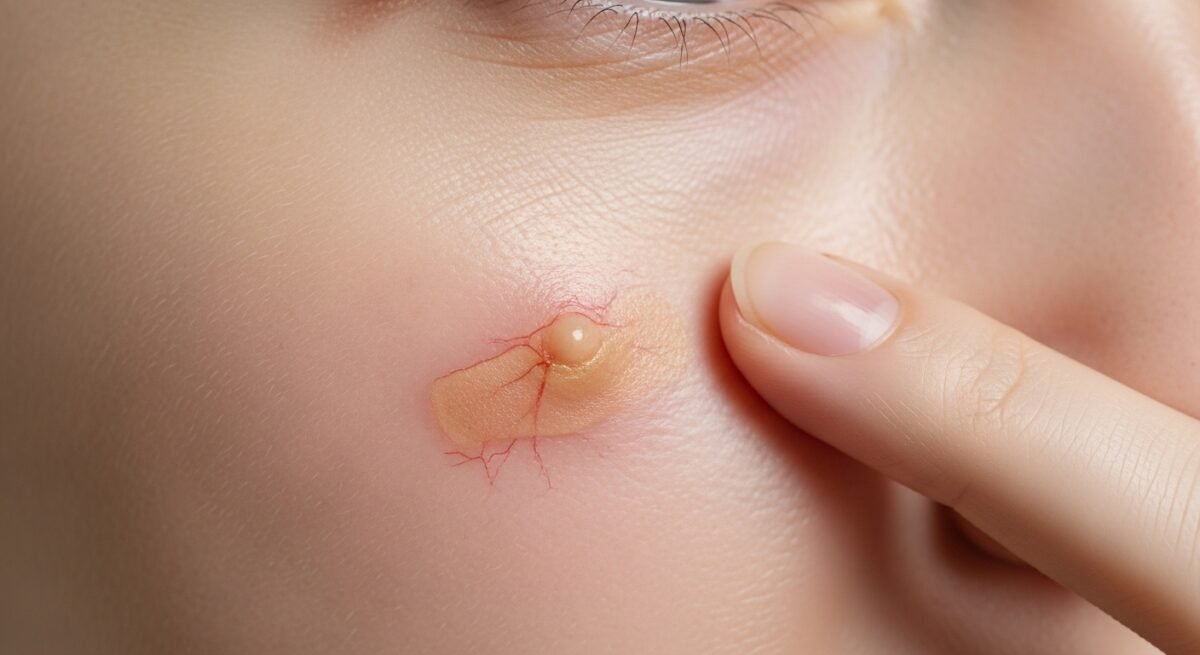
When people search for information on an “early stage skin cancer pimple,” they are often describing a specific kind of lesion that mimics an acne bump but behaves differently. The most frequent culprit is nodular basal cell carcinoma. This type of skin cancer often presents as a small, shiny, pearly, or translucent bump that can be pink, red, white, or even the color of your skin. It may have tiny blood vessels on its surface, which dermatologists call telangiectasias. The key distinction from a regular pimple is its persistence and evolution. While a pimple follows a predictable lifecycle of inflammation, pus formation, and healing over days or a couple of weeks, an early skin cancer lesion lingers. It may crust or bleed with minor trauma, like washing your face, seem to heal partially, and then break open again, a cycle that repeats over months. This non-healing quality is a major red flag. Another form, squamous cell carcinoma, can appear as a firm red nodule or a flat sore with a scaly crust. Both types are primarily caused by cumulative ultraviolet (UV) radiation exposure from the sun or tanning beds.
The ABCDEs and Beyond: A Self-Check Framework
The ABCDE rule for melanoma is well-known, but it’s less helpful for identifying the more common non-melanoma skin cancers that often look like pimples. For these, dermatologists emphasize a different set of observations. Use this framework to evaluate any new or changing growth on your skin. Look for the following characteristics that distinguish a potential skin cancer from a benign pimple.
- Persistence: The lesion does not heal within 4 weeks. It remains stable or grows slowly.
- Change: It changes in size, shape, color, or texture over time. It may become more raised or develop a depression in the center.
- Bleeding or Oozing: It bleeds easily with minimal contact or appears to ooze clear or yellowish fluid that crusts over.
- Border and Surface: While often round, the edges might be rolled or raised. The surface may be smooth and shiny (like a pearl) or scaly and rough.
- Sensation: While usually not painful, it might itch, feel tender, or cause a prickling sensation.
It is crucial to perform these checks in good lighting and to enlist a partner to help examine hard-to-see areas like your back and scalp. A simple monthly self-exam can be lifesaving. If you notice any skin changes that concern you, especially those fitting the description above, scheduling a professional skin check is the next essential step. Early detection simplifies treatment and leads to excellent outcomes.
Diagnosis and Professional Evaluation
If you have a suspicious spot, a visit to a dermatologist is non-negotiable. Do not attempt to diagnose or treat it yourself. The dermatologist will conduct a thorough visual examination, often using a dermatoscope, a handheld device that magnifies and illuminates the skin, revealing structures not visible to the naked eye. Based on their clinical assessment, if skin cancer is suspected, the next step is a biopsy. This is a simple, in-office procedure performed under local anesthesia. The dermatologist will remove all or part of the lesion and send it to a lab for pathological analysis. The biopsy is the only definitive way to diagnose skin cancer and determine its type. Waiting and hoping a “pimple” will go away can allow a small, easily treatable cancer to grow deeper and become more complex to manage. As explored in our guide on early stage AIDS symptoms skin, many systemic conditions can manifest with skin changes, underscoring why professional evaluation is key for any persistent lesion.
Treatment Options for Early Non-Melanoma Skin Cancer
The good news is that when caught early, basal and squamous cell carcinomas have a very high cure rate. The chosen treatment depends on the cancer’s type, size, location, and the patient’s overall health. For a small, early lesion initially mistaken for a pimple, treatment is typically straightforward and highly effective. Here are the most common procedures used for early-stage non-melanoma skin cancers.
Excisional surgery is the most common treatment. The dermatologist or surgeon cuts out the cancerous tissue along with a small margin of healthy skin around it to ensure complete removal. The wound is then closed with stitches. For very superficial cancers on the trunk or limbs, curettage and electrodesiccation (C&E) might be used. The doctor scrapes away the tumor with a curette (a sharp, ring-shaped instrument) and then uses an electric needle to destroy any remaining cancer cells and control bleeding. This process may be repeated. Mohs micrographic surgery is a specialized, tissue-sparing technique used for cancers in cosmetically sensitive areas (like the nose, ears, lips) or for recurrent tumors. The surgeon removes thin layers of skin one at a time and examines each under a microscope during the procedure, stopping only when no cancer cells remain. This maximizes removal of the cancer while preserving as much healthy tissue as possible.
Other options for specific cases include topical chemotherapy creams, immune response modifiers, radiation therapy, and photodynamic therapy (PDT). Your dermatologist will recommend the best approach for your specific situation. The goal is always complete removal with the best possible cosmetic and functional outcome. For more detailed insights on navigating health coverage for such procedures, Read full article provides additional details.
Prevention and Risk Reduction
While treatment is effective, prevention is always superior. The primary cause of nearly all non-melanoma skin cancer is UV radiation. Therefore, consistent sun protection is your best defense. Make broad-spectrum sunscreen with an SPF of 30 or higher a daily habit, even on cloudy days and during winter. Apply it generously to all exposed skin and reapply every two hours when outdoors, or more often if swimming or sweating. Seek shade, especially between 10 a.m. and 4 p.m. when the sun’s rays are strongest. Wear protective clothing, including long-sleeved shirts, pants, a wide-brimmed hat, and UV-blocking sunglasses. Avoid tanning beds entirely, as they emit intense UV radiation that dramatically increases your risk. Regular self-exams and annual professional skin checks by a dermatologist are also part of a comprehensive prevention strategy, especially if you have a personal or family history of skin cancer, fair skin, light eyes, many moles, or a history of blistering sunburns. Understanding your personal risk factors, similar to being aware of how conditions like HIV can present dermatologically as discussed in early stage AIDS symptoms on the skin, empowers proactive health management.
Frequently Asked Questions
Can a pimple really turn into skin cancer?
No, a common pimple (acne) cannot transform into skin cancer. They are entirely different processes. However, a new growth that you mistake for a pimple can be skin cancer from its inception. The concern is misidentification, not transformation.
How long does a skin cancer “pimple” typically last?
A lesion that is actually an early skin cancer will persist for months, often with a cycle of bleeding, scabbing, and re-opening. If a bump hasn’t resolved on its own within a month, have it evaluated.
Is it painful?
Early basal and squamous cell carcinomas are often not painful. They may itch, bleed, or feel tender, but the absence of pain does not rule out cancer. Melanomas are also usually painless in their early stages.
What if I pop it and it bleeds a lot?
One hallmark of these skin cancers is that they bleed very easily with minor trauma. If you pick at a spot and it bleeds more profusely or for longer than a typical pimple would, it’s a significant warning sign.
Who is most at risk?
Individuals with fair skin, light hair and eye color, a history of sunburns, extensive sun exposure, use of tanning beds, a personal or family history of skin cancer, a weakened immune system, or older age are at increased risk.
Vigilance about changes in your skin is one of the most direct forms of healthcare you can practice. A growth that looks like a stubborn pimple but behaves oddly is your skin signaling for a professional opinion. Do not dismiss it. Early detection of skin cancer leads to simpler treatments, higher cure rates, and better cosmetic results. Schedule a skin check with a board-certified dermatologist if you have any doubts, and commit to sun-safe behaviors every day to protect your skin’s future health. Your awareness and action are the ultimate keys to prevention and successful outcomes.
Compare health plans
Finding plans in your area…